Maggie Gyllenhaal Plays Van Helsing in Audible’s Dracula
Published on · Updated on
Maggie Gyllenhaal plays Van Helsing in Audible’s audio adaptation of Dracula and explains why a woman’s perspective fits the unconventional professor.
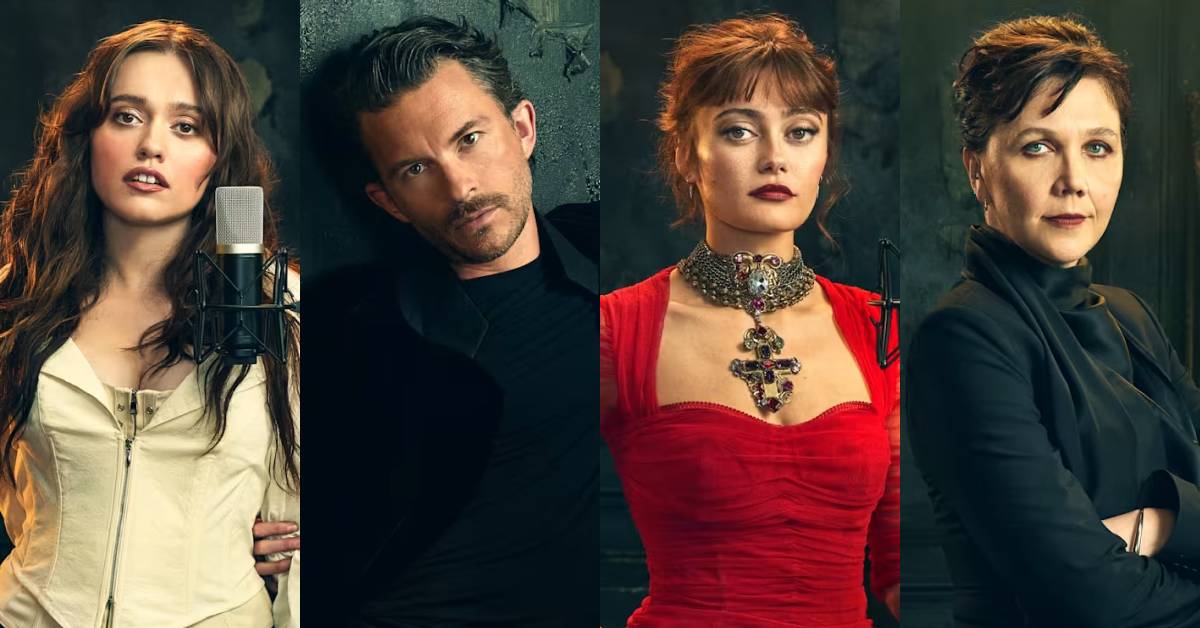
Maggie Gyllenhaal plays Professor Van Helsing in Audible’s new audio adaptation of Dracula, released on October 1, 2026. In an interview with CBR published this week, the actor and filmmaker discussed finding a woman’s perspective for a character traditionally played by men and the challenge of performing without images, relying on the microphone alone. The full-cast production also features Jonathan Bailey as the Count and Ella Purnell as Mina, with Mary Lambert directing.
A performance built from sound
This is more than one narrator reading a novel aloud. Audible presents the title as an original full-cast adaptation, with dramatized performances and sound design. That changes the actors’ work: instead of describing actions and dialogue, they must build a scene through voice, rhythm, breath, and audible reactions. The story reaches listeners without the visual layer that usually guides attention in film or television.
Gyllenhaal told TV Insider that the experience called for different tools than those she uses on a film set. She did not perform in person with the rest of the cast and had to imagine the action while recording. The actor also said the team asked her to make physical sounds, such as exertion and movement, so the performance would work in an acoustic environment. It highlights a practical difference between narrating an audiobook and acting in an audio drama: the voice must carry both intention and part of the action.
“It’s only sonic, so that was new to me.”
She said returning to acting after years focused on writing, directing, and producing made the invitation especially unexpected. Recording, she described, was a new experience, with moments of discomfort and excitement. That account gives context to her return: it is not an announced restart of her acting career, but a one-off performance in a format that offered a different kind of preparation and presence.
Why Van Helsing can be played by a woman
In Bram Stoker’s 1897 novel, Abraham Van Helsing is a Dutch professor called in to help confront Dracula. The new production keeps the character’s central function but casts Gyllenhaal in the role. Rather than describing the change as a simple gender swap, the actor connects it to the way Van Helsing thinks: the professor combines knowledge and intuition and is willing to consider explanations others dismiss.
In her conversation with TV Insider, Gyllenhaal described the professor as intelligent, unconventional, and open to the irrational. To her, standing outside convention resembles women’s experience in societies that do not always recognize different ways of interpreting the world as legitimate. The casting thus becomes a starting point for a new reading of the character, while acknowledging that Stoker wrote the original Van Helsing as a man.
“It fit quite easily into being played by a woman.”
The change also speaks to the novel’s structure, which presents events through documents, letters, and accounts from different characters. An audio adaptation has to turn that arrangement into voices, dialogue, pauses, and environments. A performer bringing another experience to Van Helsing does not alter Stoker’s book; it draws attention to possibilities that emerge when a classic work is retold in a new form.
An ensemble shares the story
Jonathan Bailey plays Dracula, and Ella Purnell voices Mina. Audible’s official cast guide also lists Aimee Lou Wood as Lucy, Louis Partridge as Jonathan Harker, David Jonsson as Dr. Seward, Johnny Flynn as Renfield, and Lesley Manville as Mrs. Westenra. Mary Lambert directs, and Ilan Eshkeri composed the original score.
The ensemble matters because the novel advances through the accounts of several witnesses and perspectives. A full cast can distinguish voices and give each account its own identity, while the director shapes transitions between places and moments. The format does not need to show the castle or its characters: sound, performance, and music suggest threats and movement without turning every detail into spoken explanation.
Audible says the adaptation has seven language editions, with casts from different regions. The Brazilian Portuguese version, however, is scheduled for 2027. October’s date therefore marks the English production and other editions, rather than the immediate arrival of every version in Brazil. That distinction helps separate the international announcement from the catalogue available in each territory.
Gyllenhaal returns to monster stories
Dracula also connects with The Bride!, the film Gyllenhaal wrote, directed, and produced, which reimagines the world of Frankenstein and opened in theaters in March 2026. The projects use different formats but share an interest in monsters and in the perspective of characters often pushed to the margins of classic stories. In the audio drama, Gyllenhaal performs as Van Helsing; in the film, she led the story behind the camera and built a new version of the Bride.
This connection does not mean Audible’s adaptation is part of the film or shares its plot. The common thread is reinterpretation: a familiar work can be presented through another voice, a new ensemble, or a character who previously had little space. CBR’s interview brings the projects together by asking about women’s perspectives, but the audio drama is an independent Audible production.
Gyllenhaal told TV Insider that trying something new was both “uncomfortable and exciting.” The remark captures the project without promising that she will immediately take on more acting roles. For now, Audible offers a performance distinct from her recent filmography and places Van Helsing at the center of an experience in which listeners’ imaginations fill in what a camera would normally show.
Where to listen
The English version of Bram Stoker’s Dracula has been available on Audible since October 1, 2026. The platform describes it as a dramatized original production with a full cast, directed by Mary Lambert and featuring music by Ilan Eshkeri. Listeners specifically looking for a Brazilian Portuguese edition should note the schedule published by the company: that version is expected in 2027.
By casting Gyllenhaal, the production offers a different entry point into a character associated with many adaptations. The interest is not only in who plays the vampire hunter, but also in how the professor’s reasoning, voice, and sound design reshape the relationship between the classic and a current audience. This retelling keeps Dracula recognizable while making room for a new performer to find her own path to Van Helsing. At Revista Pixel, the subject also connects with coverage of films and pop culture.
Suggested and related articles
Wicker Expands to 2,300 North American Theaters

Ali G hits Prime Video five days after theaters

Peter Berg says Call of Duty film will explore war's cost
Cara-de-Barro: DC brings body horror to Gotham
Project Power: the pill that grants five minutes of power