Lanterns VFX reveals hidden effects
Published on · Updated on
A CoSA VFX featurette shows how Lanterns turned California locations into Nebraska, with digital landscapes, dust, bullet hits and a beard created for John Stewart.
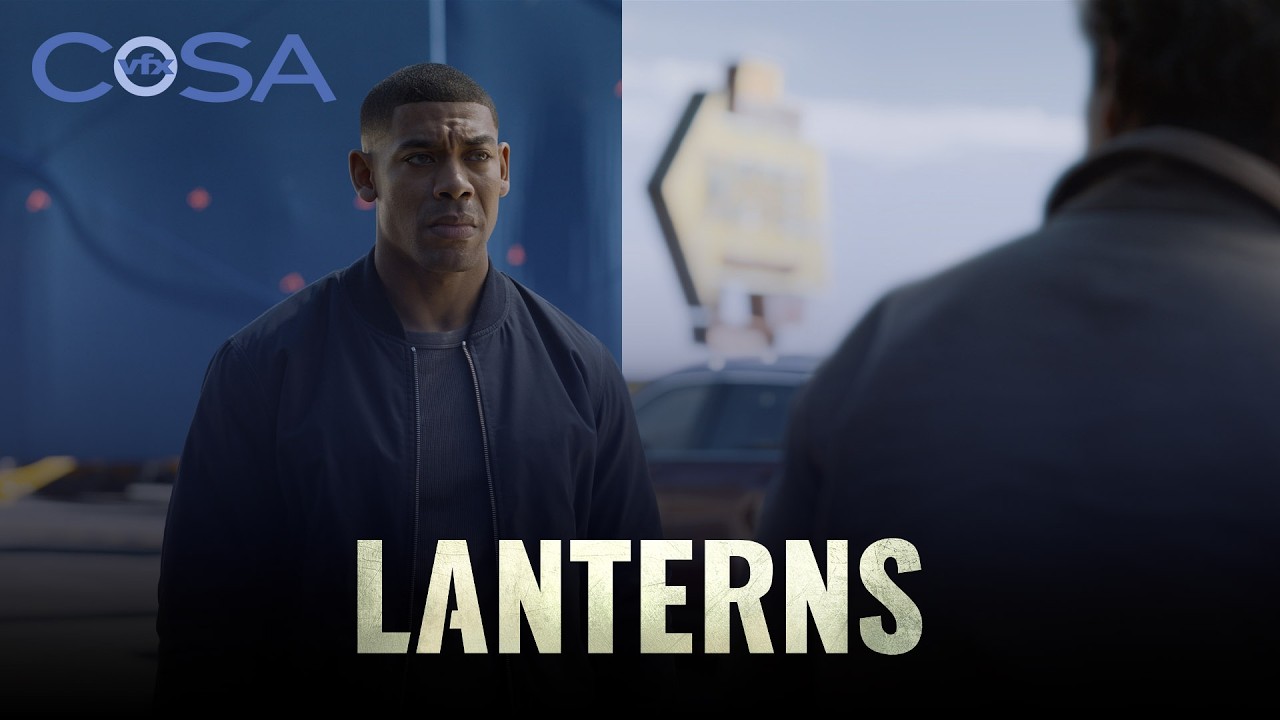
CoSA VFX has released a behind-the-scenes featurette showing the digital work hidden in apparently ordinary scenes from Lanterns, HBO’s series about the Green Lanterns. Overall VFX producer Eddie Bonin and supervisor Christopher Lance explain how California locations were reshaped to represent Rushville, the fictional Nebraska town where Hal Jordan and John Stewart investigate a case. The breakdown also covers simulated dust and bullet hits, along with a less obvious touch: John’s beard was created digitally to mark the passage of time.

When an effect needs to disappear
The featurette does not focus on a Lantern construct or a computer-generated creature. Instead, it shows restrained changes meant to go unnoticed: removing mountains and trees that would reveal the real location, rebuilding the horizon, and matching terrain, sky and light. The goal is to keep the actors inside a believable environment without making the composite more noticeable than the scene.
This work is often called invisible visual effects. The team does not necessarily add a fantastic object; it may erase or replace parts of the frame to preserve continuity. Viewers see a coherent landscape, while a shot may combine original footage, rebuilt backgrounds, color corrections and simulated elements. Each layer has to look as if it belongs to the same place and moment.
That approach fits Lanterns, which brings comic-book mythology into a small-town crime drama. The investigation and the relationships stay in the foreground. To preserve that intimacy, post-production can be restrained: making the geography feel natural matters more than displaying the tool that achieved it.
“We had to swap the terrain and skies, sometimes even the quality of light, to change the West Coast into the Great Plains.”
California in place of Nebraska
Rushville is fictional, but the story places its investigation in Nebraska. Production filmed in California, and Lance describes the challenge as adapting what the camera captured without losing the feeling of a real place. The work includes changing terrain and skies, sometimes adjusting the quality of light, and removing Los Angeles scenery that does not fit the intended geography.
The Television Academy reports that Piru, California, doubled for Rushville and that some filming took place near Pomona. Co-creator Chris Mundy described one part of the effects work as “getting rid of mountains and creating Nebraska horizon.” The phrase shows that the transformation can be subtractive: rather than adding an entire digital set, artists remove clues to the location and rebuild what should be visible in the distance.
A replacement horizon has to respect camera height and movement, perceived distance and the light already falling on the actors. If a digital mountain does not follow perspective, the eye notices; if the sky has the wrong contrast or color, the shot loses unity. Light can vary between takes and still must support continuity within a scene. The work is therefore more complex than placing a Nebraska image over California footage.
CoSA’s video makes stages of the process easier to see. Comparing the plate—the filmed shot used as the basis for a composite—with the final image reveals what was removed, rebuilt or adjusted. It also helps distinguish documented information from guesswork: the studio presents examples and explains challenges, but does not publish a full count of altered scenes or labor hours.
Dust and impacts support the action
Alongside the landscapes, the team simulated dust clouds and bullet hits. These details must respond to the action in frame: dust has direction, volume and speed, and an impact needs to line up with the point struck and the rhythm of the scene. If an element feels detached from the image, the effect stops being invisible and begins to compete for the viewer’s attention.
Compositing brings together the footage, digital elements and adjustments needed to make them appear to have been captured by the same camera. Artists can rebuild areas of a background or add particles, but they still need to preserve the original material’s texture. Movement, focus, grain and lighting all constrain the result. A small effect may require a chain of decisions precisely because it sits beside real faces and objects.
The breakdown also makes clear that visual effects do not mean only space scenes. CoSA describes environment work and touch-ups tied to ground-level action. Other companies handled different work on the series: CG Channel lists Accenture Song, Digital Domain, Distillery VFX, El Ranchito, Fin Design + Effects, Ghost VFX, Image Engine, Refuge VFX, Spin VFX and Twin Pines. The list does not assign every shot to every studio, but it shows the collaboration behind post-production.
John Stewart’s digital beard
One of the most unusual examples is the beard worn by John Stewart, played by Aaron Pierre. Lance says the team needed to show facial hair growing during an extended mission. Scans of Pierre’s face provided the basis for generating hair that matched the actor’s facial geometry and the intended stage of growth.
The adjustment solves a continuity problem and also carries story information. Instead of relying only on dialogue to say time has passed, John’s appearance offers a visual clue. The effect must preserve the actor’s identity and fit the shots in which it appears; beard, skin, expression and lighting interact, so a convincing change takes more than drawing hairs over an image.
The example shows why a subtle intervention can matter to the narrative. Viewers may not identify the beard as computer-generated, but they can read a coherent change in the character. The work supports the performance and the passage of time without turning the face into a technical demonstration detached from the scene.
What the featurette does and does not show
Lanterns combines two visual scales: Green Lantern mythology and an investigation in a rural community. The effects CoSA describes help connect them. Altered landscapes keep the story in Nebraska; dust and impacts complete the action; the beard tracks the length of a mission. Different tasks meet around the same requirement: continuity.
The video does not disclose the season’s budget, confirm plans for another season or show that every shot received the same amount of work. It documents CoSA’s contribution and the examples Bonin and Lance present. That scope is useful: it reveals one part of the production pipeline without turning missing information into a claim.
Watch the featurette below. For more entertainment coverage from Revista Pixel, read about HBO’s Harry Potter adaptation and DC’s Clayface movie. This report draws on the official CoSA VFX video, the breakdown published by CG Channel, and production history compiled by the Television Academy.
Suggested and related articles
Jamie Dornan says Aragorn will always be Viggo
Sukiyaki: the song behind Tokyo’s festival opener
Lord and Miller leave Star Wars return open
Paramount Completes Warner Acquisition and Reshapes Hollywood
The Batman Part II Halts Production as Reeves Steps Away